
Stimuli-Responsive Materials.
We design responsive polymers and nanomaterials that assemble, reorganise and interact with their surroundings in controlled ways. By linking molecular structure to changes in assembly, exchange and function, we aim to understand and exploit dynamic behaviour across systems ranging from polymer nanoparticles to interactions with lipids, biomolecules and complex membrane environments.
How does polymer structure control the formation, stability and reorganisation of nanoscale assemblies?
How do responsive polymers interact with other soft materials, including lipids, proteins and biological membranes?
What governs exchange of molecules between dynamic nanostructures and their surrounding environment?
Making the connection
We combine responsive polymer synthesis with self-assembly, nanoscale characterisation and functional testing to understand how molecular design controls dynamic behaviour. Our methods include controlled polymerisation, light scattering, chromatography, fluorescence spectroscopy, SAXS and mass photometry, alongside membrane and biomolecular assays where appropriate. By following how structures form, exchange, reorganise and respond to changes in their environment, we can connect polymer chemistry to nanoscale structure and function.
Related research
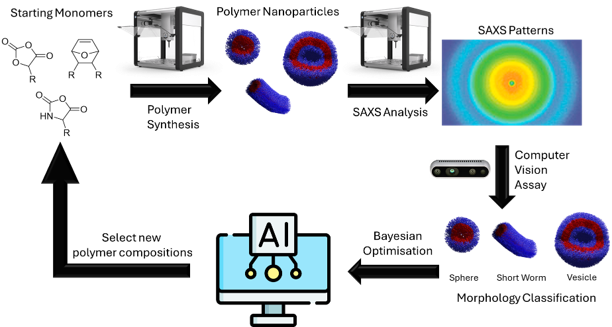
Autonomous materials discovery
Connecting synthesis, measurement and machine learning to explore polymer chemistry more intelligently
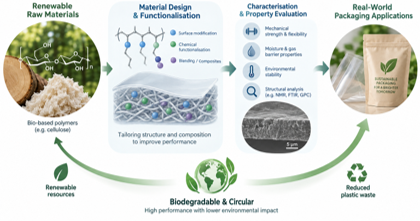
Sustainable polymer materials
Creating sustainable polymers from renewable resources with performance and end-of-life built into their design